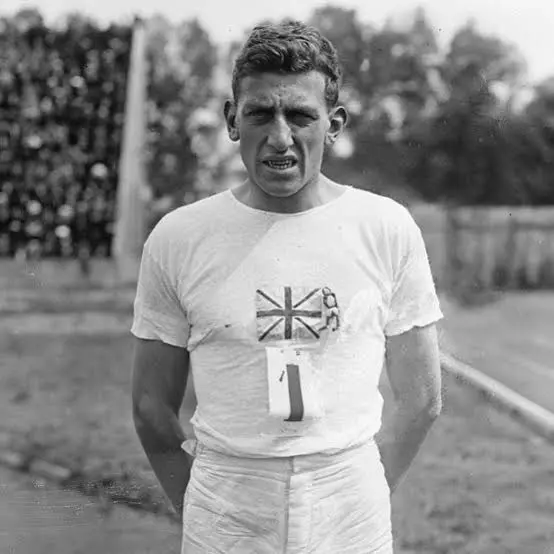
Sprinter, lawyer, and pioneer — Harold Abrahams ran not just for a medal, but to prove
that determination and talent could overcome prejudice. His 1924 Olympic gold remains
one of sport's most enduring stories.
Biography
Harold Maurice Abrahams was born on 15 December 1899 in Bedford, England, the youngest
of six children in a Jewish family of Lithuanian descent. His father, Isaac Abrahams,
had emigrated from Lithuania to England, building a life for his family through hard work
and ambition — values he instilled deeply in his children.
Harold was educated at Bedford School before winning a scholarship to Gonville & Caius
College, Cambridge, where he studied law. Cambridge would become both the stage for his
athletic rise and the crucible of the social pressures he faced as a Jewish man in 1920s
British society.
A man of formidable intellect and drive, Abrahams later qualified as a barrister and
pursued a distinguished career in sports administration, broadcasting, and journalism
alongside his athletic achievements.
"I am going to take them by storm and if they don't like it, it's too bad." — Harold Abrahams
Personal Life
In 1936, Harold Abrahams married Sybil Evers, a celebrated soprano and musical comedy
actress who had performed on the West End stage. The two moved in overlapping social
circles in London — Abrahams was by then a prominent figure in British athletics
administration and broadcasting, and their shared love of music and the arts drew them
together. They remained married until Abrahams's death in January 1978.
The couple did not have children of their own, but theirs was by all accounts a close
and devoted partnership. Sybil was a steady presence throughout the later decades of
Harold's public life, accompanying him as he became one of the most respected voices in
British sport — a BBC commentator, athletics administrator, and tireless advocate for
the sport he loved.
Athletic Career & The 1924 Paris Olympics
Abrahams showed exceptional sprinting ability from a young age. At Cambridge, he became
one of the most celebrated athletes in the university's history, winning the Amateur
Athletic Association (AAA) 100 yards title and making his mark on the British athletics
scene throughout the early 1920s.
In 1924, he became the first man to complete the long jump and all the sprints at the
Oxford–Cambridge match. His dedication to the sport was total — he hired professional
coach Sam Mussabini, a controversial move at a time when amateurism was considered the
only honourable approach in British athletics, and trained with scientific precision
that was far ahead of its era.
The VIII Olympiad, held in Paris in the summer of 1924, is where Harold Abrahams
cemented his place in history. Competing in the 100 metres — the most prestigious event
in track and field — he faced some of the fastest men in the world, including the
formidable American sprinters.
On 7 July 1924, Abrahams crossed the finish line first in 10.6 seconds, winning the
gold medal and becoming the first European to win the Olympic 100 metres. The achievement
was extraordinary: not just for British athletics, but as a statement that talent and
preparation could overcome any obstacle.
Abrahams's 10.6 second run equalled the existing world record and stood as the
European record for decades. He also competed in the 200 metres and the 4×100 metres
relay at those Games.
His coach, Sam Mussabini, watched the race from a nearby hotel room — banned from the
stadium as a professional. When the result came through, he reportedly wept with joy,
alone in his room.
Abrahams's career was cut short in 1925 when he suffered a serious injury while long
jumping, breaking his leg. He never competed again at the top level, but his impact on
British athletics continued for decades through coaching, administration, and advocacy.
Battles with Antisemitism
Throughout his life, Harold Abrahams confronted antisemitism in a society where
discrimination was often polite, subtle, and deeply ingrained in institutions. At
Cambridge, he encountered an atmosphere of casual prejudice — Jewish students were
frequently excluded from social clubs, patronised by faculty, and made to feel they
were tolerated rather than welcomed.
Abrahams was acutely aware that he was running not just for himself, but against those
who doubted his place in British society. His athletic success was, in part, a deliberate
act of defiance. He channelled the frustration of facing prejudice into fuel for his
training — a dynamic powerfully depicted in the 1981 film Chariots of Fire.
Even after his Olympic triumph, he faced institutional resistance. The British athletics
establishment disapproved of his use of a professional coach, viewing it as ungentlemanly
— a criticism that many felt was directed partly at his outsider status as a Jewish athlete.
"I will never forget the words of my housemaster: 'You know, Abrahams, I think you
push yourself forward too much.' I remember feeling, is he talking to me as an
individual — or as a Jew?"
Abrahams was vocal in later life about the discrimination he had faced and became an
advocate for equality in sport, using his public platform as a broadcaster and journalist
to challenge prejudice wherever he encountered it.
Legacy
Harold Abrahams's legacy extends far beyond a gold medal. He transformed British
athletics through decades of service as a journalist, BBC commentator, and administrator.
His commentary on athletics for the BBC lasted from the 1920s through to the 1960s,
bringing the sport to millions of listeners across the country.
He served as chairman of the British Amateur Athletic Board and was a key figure in
shaping the governance of the sport in Britain for much of the twentieth century.
He was also a strong supporter of the Jewish community and a respected voice on matters
of equality and inclusion in sport.
In 1981, three years after his death, the Academy Award–winning film Chariots of
Fire brought his story to a global audience — dramatising his journey from Cambridge
to Olympic gold and his battles against prejudice. The film won four Oscars, including
Best Picture, and introduced Abrahams to generations who had never heard his name.
Harold Abrahams died on 14 January 1978 in London. He is remembered as an Olympic
champion, a pioneer, and a man who refused to let prejudice define the limits of
his ambition.